As the global energy storage market continues to expand, customers are no longer evaluating battery energy storage systems solely by capacity or power output. Greater attention is being placed on flexibility, lifecycle cost, and long-term serviceability.
Different applications demand different system configurations. At the same time, minimizing downtime and simplifying maintenance has become increasingly important for maximizing return on investment (ROI).
Designed to address these evolving requirements, ZetaCube adopts an innovative split architecture that combines flexible electrical design with simplified maintenance, helping customers build energy storage systems that are easier to deploy, easier to operate, and easier to expand over time.
Flexible Architecture: Built Around Your Project
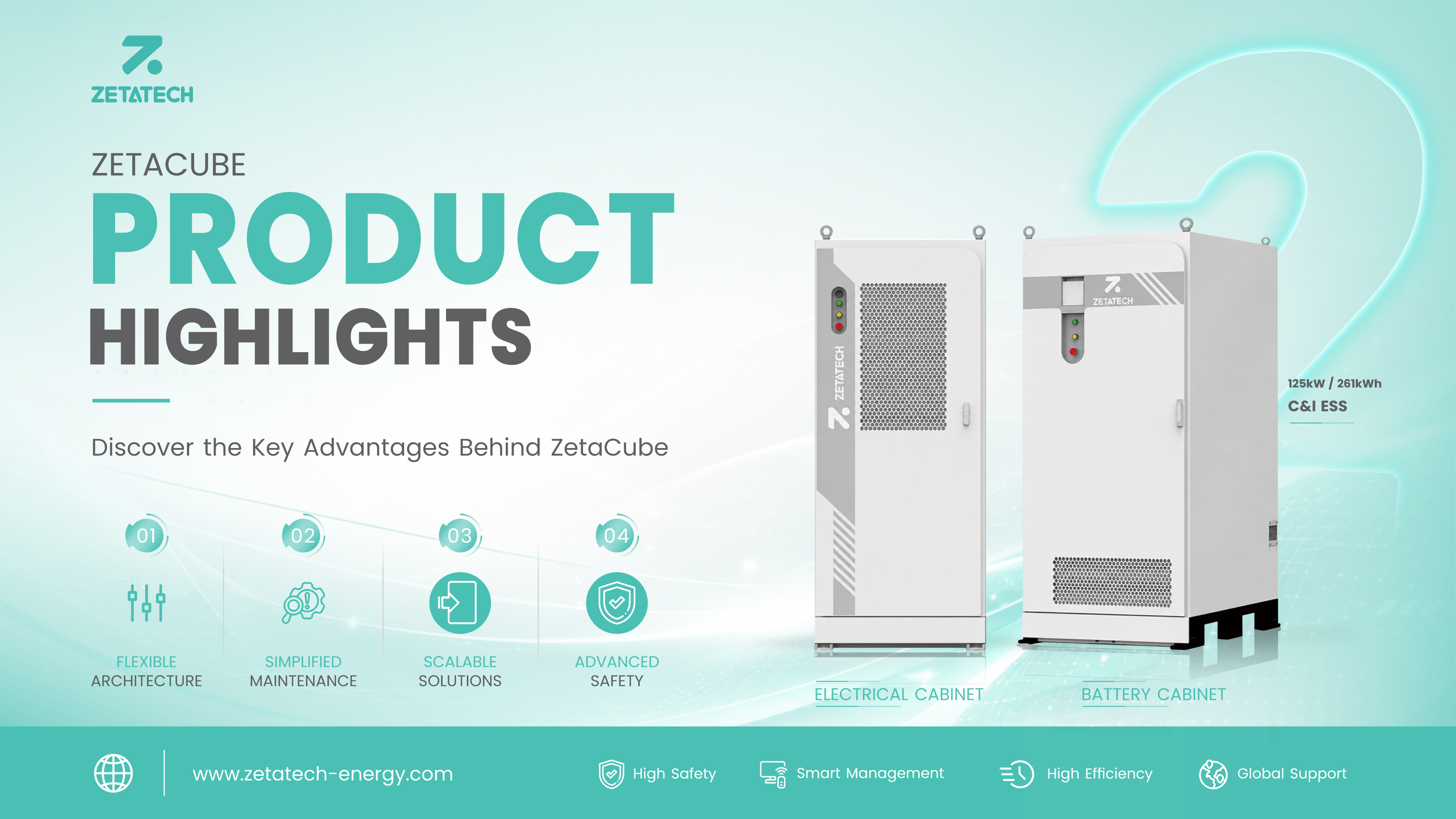
Unlike conventional all-in-one energy storage systems, ZetaCube separates the battery cabinet and electrical cabinet into independent units.

This split architecture gives project developers significantly greater freedom when designing energy storage systems. Battery capacity and PCS power can be configured independently to match different project requirements, supporting standard 1MWh and 2MWh configurations with one single electrical cabinet's output power capable of reaching 500kW.
More importantly, the electrical cabinet can be customized with project-specific components, including PCS, STS, MPPT, transformers, and other electrical modules, allowing the system to adapt to diverse grid requirements and application scenarios.
From factories and commercial buildings to microgrids and PV + Storage projects, the architecture provides a foundation for highly adaptable C&I energy storage solutions.
Simplified Maintenance: Lower Lifetime Operating Costs
A flexible system is only valuable if it remains easy to maintain throughout its operating life.

ZetaCube's split architecture separates electrical and battery systems, making every major component more accessible during inspection and servicing. Service engineers can quickly locate and access key modules—including the PCS, EMS, power distribution system, switchgear, STS, and MPPT—without unnecessary disassembly.
This streamlined layout supports a smarter maintenance workflow:
Fault Detection
↓
Fault Isolation
↓
Component Access
↓
Quick Recovery
By isolating electrical and battery systems, troubleshooting becomes faster and more accurate, reducing maintenance complexity while minimizing operational downtime.
For project owners, this means lower maintenance costs, faster service response, and improved system availability over the entire lifecycle—critical advantages for businesses where uninterrupted operation directly impacts productivity and profitability.
FAQ
Q1: Why is a split architecture better than an all-in-one design?
A split architecture allows battery capacity and electrical components to be configured independently, giving greater flexibility to match different project sizes, power requirements, and upfront budget. It also makes future upgrades and system modifications much easier without replacing the entire system.
Q2: Can ZetaCube be customized for different project requirements?
Yes. The electrical cabinet supports customized configurations, including PCS, STS, MPPT, transformers, and other electrical modules. This allows developers to tailor the system for grid-connected, microgrid, PV + Storage, and other C&I applications.
Q3: How does the design reduce maintenance costs?
Because the battery cabinet and electrical cabinet are physically separated, service engineers can access key electrical components directly. Faster fault diagnosis, easier component replacement, and reduced disassembly help shorten maintenance time and lower labor costs.
Q4: What practical benefits does faster maintenance bring to customers?
Reduced service time means shorter system downtime, higher equipment availability, and less interruption to business operations. For factories, commercial buildings, and other critical facilities, this translates into improved operational reliability and a better return on investment over the system's lifetime.